Memories of Murder: A Relentless Pursuit of the Unseen
Bong Joon-ho’s Memories of Murder, released in 2003, is not merely a crime thriller; it’s a visceral excavation of a nation’s trauma, a masterclass in tone, and an unsettling portrait of human fallibility. Long before he captivated global audiences with Parasite, Bong delivered this neo-noir masterpiece, a film that refuses easy answers and instead plunges the viewer into the agonizing abyss of an unsolved mystery. It’s a work that lingers, not just for its narrative tension, but for its profound commentary on justice, incompetence, and the chilling ordinariness of evil.

The Anatomy of a Nightmare
Set in the rural Gyeonggi Province of South Korea in 1986, Memories of Murder plunges us into a landscape of burgeoning dread. The film opens with the discovery of two brutally raped and murdered women, marking the grim commencement of South Korea’s first documented serial killings. The local police force, led by the boorish, instinct-driven Detective Park Doo-man, played with astonishing depth by Song Kang-ho, is woefully unprepared for such a heinous crime wave. Their investigative methods are crude, often relying on superstition, coercion, and outright brutality, a stark reflection of the country’s authoritarian era. The arrival of Detective Seo Tae-yoon, a more meticulous and scientifically minded officer from Seoul, portrayed by Kim Sang-kyung, injects a desperate hope into the investigation, but his modern approach inevitably clashes with Park’s old-school tactics. This fundamental discordance between intuition and evidence forms the narrative backbone, propelling a relentless, yet ultimately futile, search for an elusive phantom. The film is a chilling procedural, but one deeply infused with dark humor and tragic irony, refusing to be pigeonholed into a single genre.
Faces of Obsession
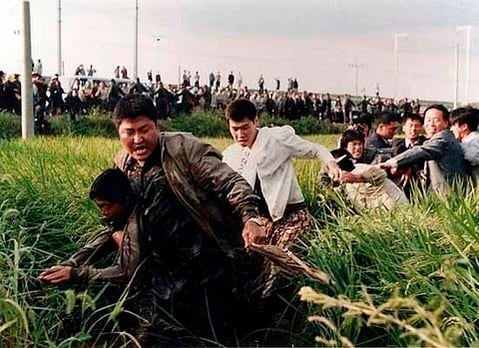
The performances anchoring Memories of Murder are nothing short of phenomenal, particularly the dynamic between Song Kang-ho’s Detective Park and Kim Sang-kyung’s Detective Seo. Song, in a role that solidified his status as one of South Korea’s finest actors, crafts Park Doo-man as a man simultaneously bumbling and fiercely determined, a figure whose initial confidence in his “shaman eyes” slowly erodes into desperate frustration. His journey from a swaggering local cop to a haunted man is subtly devastating. Kim Sang-kyung’s Seo Tae-yoon is his perfect foil: initially calm and logical, his meticulous pursuit of facts eventually gives way to a simmering rage, pushing him to the brink of the very brutality he initially disdained. The supporting cast, including Kim Roi-ha as Park’s equally rough-and-tumble partner Detective Cho Yong-koo, and Park Hae-il as the enigmatic key suspect Park Hyeon-gyu, contribute layers of raw authenticity to this bleak tableau. Their collective descent into obsession and despair is palpable, painting a vivid picture of the toll such a case takes on those entangled within it.
A Canvas of Desperation
Bong Joon-ho’s directorial vision for Memories of Murder is a masterclass in atmospheric storytelling. Cinematographer Kim Hyung-koo’s work is visually stunning, capturing the haunting, mist-shrouded countryside with a palpable sense of unease. The deliberate use of color, with red often signifying victims and sometimes serving as a misleading red herring, and green evoking mystery and malaise, adds a subtle yet powerful layer to the visual narrative. Beyond the visual, Bong expertly weaves together moments of tension, unexpected humor, and profound introspection, creating a rhythm that is both unsettling and deeply engaging. The film’s sound design, too, plays a crucial role, with the recurring radio broadcast of a specific melancholic song on rainy nights becoming an ominous harbinger of death. This blend of technical brilliance elevates the film beyond a simple whodunit, transforming it into a poignant social commentary on a society grappling with its own nascent forensic capabilities and underlying political unrest. The film’s commercial success, drawing over 5 million viewers in South Korea and saving one of its production companies from bankruptcy, speaks to its immediate impact. Critically, it was widely hailed as a masterpiece, with many drawing comparisons to David Fincher’s Zodiac for its meticulous yet unresolved depiction of a true-crime saga.
The Unseen Specter
What truly elevates Memories of Murder is its unflinching confrontation with the absence of resolution. Unlike conventional thrillers that neatly tie up loose ends, this film leaves its central mystery hauntingly open, a decision Bong Joon-ho made because the real-life Hwaseong murders remained unsolved at the time of the film’s release. This narrative choice resonated deeply with audiences, leaving them with a profound sense of frustration and unease that contributed to the film’s timeless quality. The film’s profound impact is perhaps best encapsulated in its iconic final shot: Detective Park Doo-man, years after the events, revisits the initial crime scene and stares directly into the camera, into the eyes of the audience. This audacious breaking of the fourth wall transforms the viewer from a passive observer into a potential witness, or even, unsettlingly, the very killer himself. It was a rhetorical masterstroke, a desperate plea for justice that, remarkably, contributed to the re-opening of the real case and the eventual identification of the killer in 2019. This ending isn’t just a cinematic flourish; it’s a direct challenge, an unspoken question that echoes long after the credits roll: Do you know who he is?
Memories of Murder is an essential piece of cinema, a film that defies easy categorization and refuses to be forgotten. It’s a testament to Bong Joon-ho’s early genius, a searing indictment of institutional failures, and a poignant exploration of the human cost of an elusive evil. It’s not a comfortable watch, nor should it be. Instead, it’s a film that demands your attention, rewards your contemplation, and ultimately, haunts your consciousness. Watch it for its brilliant direction, its powerhouse performances, and its unwavering commitment to portraying the chilling ambiguity of true crime. But be warned: you won’t just watch this movie; you’ll experience it, and it will stay with you long after the screen goes dark.